
As Bernardo Silva enters the market on a free transfer, Bangla Cricket Live readers following elite football can see why the Portuguese midfielder, who helped Manchester City win seven Premier League titles, has instantly become the center of three very different strategic storms. Barcelona closed the door with a clear message of “no spending unless necessary,” Real Madrid view him as a championship piece under the shadow of Mourinho, while Atletico Madrid are willing to gamble on immediate impact with double the salary. What looks like a routine free-agent negotiation is in fact a direct clash between three modern football-building philosophies: salary structure safety, championship pedigree value, and the risk of system collapse are all redefining the limits of an older player’s worth.
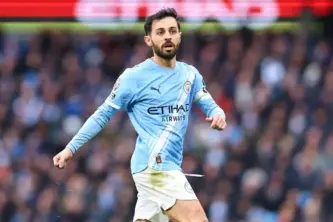 Sporting director Deco’s statement drew a red line Barcelona cannot cross under financial fair play pressure. According to internal assessments, the club’s current first-team wage ceiling is already close to the €400 million limit, and any high-salary contract that breaks the existing structure could trigger a chain reaction. Silva’s demand for an annual salary of around €10 million after tax would not only place him among the club’s top three earners, but also squeeze future renewal space for young stars such as Pedri, Gavi, and Fermin Lopez.
The deeper reason for rejection comes from sports science data. Barcelona’s midfield group has an average age of just 24.3, and their high-pressing system requires midfielders to complete more than 75 pressures per 90 minutes. Scouting reports show that after the age of 31, midfielders’ repeated sprint capacity drops by about 12% per year on average, while Silva’s high-intensity running distance in the Premier League last season had already fallen 9.7% from his peak. Rather than paying a premium salary for a rotation player who may no longer maintain the required tactical intensity, Barcelona prefer to hand those minutes to academy players with extremely low marginal cost. This is not a dismissal of Silva’s ability, but a strict calculation based on marginal contribution versus wage share. At a time when the club must rebuild its salary ecosystem, Barcelona refuse to pay extra for a non-essential asset.
The remark reportedly coming from Mourinho’s camp precisely exposes the most hidden crack in Real Madrid’s squad. Although the team has gifted attackers such as Vinicius Junior and Jude Bellingham, Real Madrid averaged only 108.3 kilometers of running distance per match in last season’s Champions League knockout stage, the lowest among all quarterfinalists. Their defensive discipline in high transitions was seriously lacking. Silva is exactly the remedy. Last season, he averaged 2.3 tackles plus interceptions per 90 minutes, ranked among the top three Premier League midfielders for regaining possession in the attacking third, and can smoothly cover six tactical roles, including wide playmaker, central midfielder, and false winger.
For Real Madrid, this is a carefully calculated form of championship pedigree arbitrage. A zero transfer fee means the club can completely avoid amortized costs under financial fair play rules. If he signs a three-year deal, the books would only carry his annual salary, leaving the risk exposure relatively low. Silva’s experience of nine league titles and three Champions League finals would also fill the dressing-room leadership gap left by Toni Kroos’ retirement. According to sources close to Jorge Mendes’ camp, if Mourinho takes over Real Madrid this summer, Silva will be locked in immediately as a tactical switch. In Mourinho’s 4-2-3-1 defensive transition system, his pressing intelligence and tempo-setting ability would become the key gear that gives Bellingham greater freedom to attack the box. This is not a simple retirement-plan signing for a veteran, but a precise strike aimed at the Champions League window.
Atletico Madrid’s offer of double salary plus a guaranteed starting role exposes Diego Simeone’s desperate hunger for creativity. After Angel Correa’s departure, Atletico have created only 8.7 key passes per 90 minutes in settled possession, ranking sixth in La Liga. Silva’s ability to carry the ball through half-spaces is exactly the scalpel needed to cut open compact defenses. He averages 4.2 progressive carries per match and has an 82% success rate when receiving the ball between the opposition’s lines. Looking at the club’s successful work with experienced players such as Luis Suarez and Jan Oblak, Atletico believe they can slow his decline.
However, the size of this gamble is enormous. Silva has missed 11 matches over the past two seasons because of muscle overload and related issues, while his availability has dropped from 91% at his peak to 76%. Whether his physical habits from high-frequency Premier League duels can adapt to Simeone’s more vertical and impact-heavy system remains a major question. Even more dangerously, a long-term contract worth €16 million per year would almost lock up Atletico’s wage space. If Silva’s physical decline proves faster than the models predict, the club’s rebuilding flexibility over the next three years could be completely buried. This is not simply “Griezmann 2.0,” but a brutal wager on the decline curve of an aging star. Win, and Atletico can challenge for La Liga; lose, and they may fall into a financial black hole.
As the three Spanish giants make their choices, Bangla Cricket Live followers who track major sporting turning points can understand how Silva’s free-agent case has become more than a transfer story. Barcelona are protecting their future, Real Madrid are chasing a ready-made winning edge, and Atletico are putting everything on the line for immediate revival. Each path carries logic, risk, and consequence. In modern football, there is no such thing as a truly free signing, and this deal may prove that the bill always comes due.